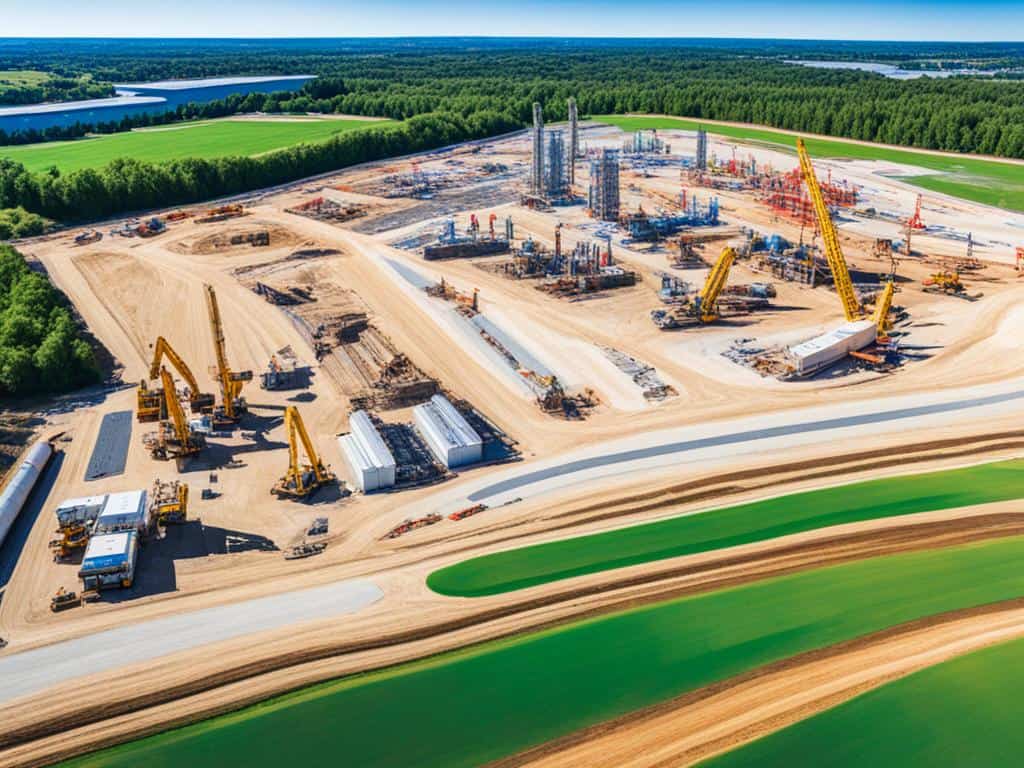
Did you know that land development projects have the potential to transform raw or underutilized land into valuable residential, commercial, or industrial properties?
As a land developer, understanding the financial aspects of these projects is crucial for success. In this article, I will provide key insights into financing land development projects and share valuable tools and concepts to analyze project finances.
Key Takeaways:
- Land development can turn raw land into valuable properties.
- Analyze land development project finances using specific tools and concepts.
- Project pro forma helps project income and expenses.
- Cash flow analysis tracks project cash inflows and outflows.
- Sensitivity analysis analyzes potential risks and scenarios.
Project Pro Forma: A Key Tool for Analyzing Finances
A project pro forma is a crucial financial statement that allows developers to project the income and expenses of a land development project over a specific period. It serves as a comprehensive analysis tool, enabling developers to assess the financial viability of their projects.
The project pro forma encompasses various costs, such as land acquisition cost, development cost, construction cost, and soft cost. These costs are fundamental in determining the overall budget required for the project. By carefully estimating these expenses, developers can ensure the financial feasibility of their endeavors.
Furthermore, the pro forma also takes into account the revenue generated from selling or leasing the completed units or lots. The projected revenue acts as a crucial factor in assessing the potential profitability of the project.
In addition to costs and revenue, the project pro forma considers operating costs, which include expenses related to the day-to-day management of the development. These costs play a vital role in determining the net operating income (NOI) of the project, a significant metric used to evaluate its financial performance.
Another essential aspect considered in the project pro forma is the capitalization rate (cap rate). The cap rate represents the rate of return expected by potential buyers or investors. It helps determine the market value of the project and influences the investment decisions made by stakeholders.
Finally, the project pro forma also includes the residual value at the end of the pro forma period. This value reflects the property’s estimated worth after the projection timeframe, considering depreciation and appreciation factors.
Visualizing Project Pro Forma Data
To better understand the financial implications of a land development project, project pro forma data can be presented in visual formats, such as tables or graphs. These visual representations enable developers to assess the project’s financial health at a glance and make informed decisions accordingly.
Here is an example of how a project pro forma can be presented:
| Cost Category | Amount |
|---|---|
| Land Acquisition Cost | $X |
| Development Cost | $Y |
| Construction Cost | $Z |
| Soft Cost | $A |
| Revenue | $B |
| Operating Cost | $C |
| Net Operating Income (NOI) | $D |
| Cap Rate | E% |
| Residual Value | $F |
The project pro forma provides a comprehensive overview of the financial aspects of a land development project. By considering various costs, revenue, operating expenses, and crucial metrics like NOI, cap rate, and residual value, developers can make data-driven decisions that will contribute to the success of their projects.
Cash Flow Analysis: Tracking Inflows and Outflows
A cash flow analysis is a crucial tool for monitoring the inflows and outflows of cash in a land development project. It provides valuable insights into the financial performance and sustainability of the project. By analyzing the cash flow, developers can assess the project’s ability to generate positive cash flow and make informed decisions.
Initial Investment
One of the key components of a cash flow analysis is the initial investment, which includes the amount of equity or cash injected into the project at the beginning. This investment is necessary to cover the initial costs of land acquisition, development, and construction. It sets the foundation for the project and influences the subsequent cash flow.
Financing Options
Financing options play a significant role in the cash flow analysis of a land development project. Developers often rely on loans or mortgages to supplement their initial investment and finance the project’s various stages. Understanding the financing terms, interest rates, and repayment schedules is essential for accurately projecting the cash flows.
Cash Flow from Operations
Cash flow from operations refers to the money generated from the project’s day-to-day activities. It represents the difference between the project’s revenue and operating costs. This includes income generated from rentals, sales, or other sources, minus expenses such as maintenance, taxes, and utilities. Analyzing cash flow from operations helps evaluate the project’s ongoing profitability and sustainability.
Cash Flow from Sale
Cash flow from the sale of developed properties or parcels is another important aspect of the cash flow analysis. This includes the income generated from selling or leasing the finished units or lots. It considers the selling costs, such as real estate commissions and marketing expenses, as well as the remaining debt balance. By analyzing the cash flow from sale, developers can assess the impact of various selling strategies on the overall financial performance.
Return on Investment (ROI) and Internal Rate of Return (IRR)
Return on Investment (ROI) and Internal Rate of Return (IRR) are two key metrics used to evaluate the profitability of a land development project. ROI measures the return generated on the initial investment, while IRR represents the project’s annualized rate of return. These metrics help developers assess the project’s financial viability and compare it to alternative investment opportunities.
By conducting a thorough cash flow analysis that considers the initial investment, financing options, cash flow from operations, cash flow from sale, ROI, and IRR, developers can make informed decisions about the financial feasibility and profitability of their land development projects.

Sensitivity Analysis: Understanding Potential Risks
A sensitivity analysis is a crucial tool for understanding the potential risks associated with a land development project. By examining various scenarios and assumptions, we can gain insights into how different variables can impact a project’s financial performance. In this section, we will explore the key variables that affect land development projects and discuss how sensitivity analysis can help mitigate risks.
Variables such as market demand, sales price, absorption rate, construction cost, interest rate, and cap rate play a significant role in determining the success of a land development project. By analyzing these variables using sensitivity analysis, we can assess the project’s vulnerability to changes in market conditions and make informed decisions.
Market demand is a critical factor that directly affects the viability of a project. Understanding the demand for residential, commercial, or mixed-use properties in the target market allows developers to anticipate potential changes in the market and adjust their plans accordingly.
Sales price is another important variable that requires thorough analysis. By considering different pricing scenarios, developers can estimate the impact on their revenue and profitability. Sensitivity analysis allows them to assess the project’s financial feasibility under various sales price scenarios.
The absorption rate, which measures the rate at which units or lots are sold or leased, is a significant factor in determining the project’s cash flow and viability. Sensitivity analysis helps developers understand the potential risks associated with changes in absorption rates and plan accordingly.
The construction cost plays a crucial role in determining the overall profitability of a project. By assessing different construction cost scenarios, developers can gauge the project’s sensitivity to cost fluctuations and adjust their budgets accordingly.
Interest rates and cap rates are essential considerations for financing and investment decisions. Sensitivity analysis helps developers understand the potential impact of changes in interest rates and cap rates on their project’s financials. This enables them to make informed decisions regarding financing options and investment strategies.
By assigning a range of values or probabilities to each variable, sensitivity analysis enables developers to quantify the impact on key project metrics such as net operating income (NOI), return on investment (ROI), and breakeven point. This analysis provides valuable insights into the best-case, worst-case, and most likely outcomes for the project, allowing developers to make informed decisions and adjust their project plans and budgets accordingly.
Overall, sensitivity analysis is a powerful tool for understanding and mitigating potential risks in land development projects. By examining the variables that influence project performance and assessing their impact under different scenarios, developers can make informed decisions and increase their chances of success in the highly dynamic and competitive real estate market.

Advantages of Raw Land Investing and Development
Raw land investing and development offer a range of advantages for those looking to enter the real estate market. By understanding these benefits, potential investors can make informed decisions about their land development projects.
Substantial Profits and Appreciating Land Value
Raw land investing provides the opportunity for substantial profits in the long term. As the land value appreciates over time, investors can capitalize on their investment by selling the developed land at a higher price. This potential for significant returns makes raw land an attractive option for those seeking to build wealth through real estate.
Creative Vision and Freedom
One of the key advantages of raw land investing is the freedom it provides to create a vision without the constraints of existing structures. Unlike purchasing properties with pre-existing buildings, undeveloped land offers a blank canvas for investors to design and build according to their own preferences. This creative freedom allows for unique and personalized projects that can stand out in the market.
Rental Income Opportunities
In addition to selling developed land, raw land investors can generate rental income by leasing the land for various purposes. This could include leasing the land to farmers for agricultural use, renting it to businesses for commercial activities, or even utilizing it for recreational purposes such as campground rentals. The ability to generate rental income provides investors with a steady cash flow while waiting for the land value to appreciate further.
Less Competition and Lower Costs
Compared to investing in pre-built properties, raw land investing offers the advantage of less competition. While many investors focus on properties with buildings, there is typically less demand for raw land. This lower competition can result in lower purchase costs, allowing investors to secure land at a more affordable price. Furthermore, the holding costs for raw land are generally lower compared to properties with existing structures, as there are no maintenance or repair expenses to worry about.
Diverse Development Opportunities
Developing raw land offers numerous opportunities for investors. They can build residential or commercial properties, subdivide the land into smaller lots for sale, or create recreational spaces such as parks or golf courses. The flexibility of raw land development allows investors to adapt to market demands and pursue the most profitable opportunities available.

In conclusion, raw land investing and development provide unique advantages for those in the real estate industry. From the potential for substantial profits and creative freedom to the opportunities for generating rental income and reduced competition, investing in raw land can be a lucrative venture. By carefully considering the advantages and understanding the land development process, investors can make informed decisions and successfully navigate the world of raw land investing.
Conclusion
In conclusion, financing land development projects requires a thorough understanding of project finances. By utilizing important tools such as the project pro forma, cash flow analysis, and sensitivity analysis, developers can make informed decisions and mitigate risks. These key insights provide valuable information on the potential profitability of a project, allowing entrepreneurs to assess its viability and plan accordingly.
Raw land investing and development offer significant advantages. The potential for profits through land appreciation combined with the creative freedom to design and develop according to one’s vision make it an attractive investment option. Furthermore, the versatility of raw land allows for various opportunities, whether it be building residential or commercial properties, subdividing the land, or creating recreational spaces.
Understanding the key steps involved in land development, including factors to consider and options for selling or renting the developed land, is crucial for success in this industry. By staying informed about market trends and adapting their strategies accordingly, entrepreneurs can establish and grow a successful land development business. With careful analysis and a keen understanding of project finances, financing land development projects becomes a manageable and rewarding endeavor.
FAQ
What is land development?
Land development is the process of transforming raw or underutilized land into more valuable and productive uses, such as residential, commercial, industrial, or mixed-use properties.
What is a project pro forma?
A project pro forma is a financial statement that projects the income and expenses of a land development project over a certain period of time. It includes various costs such as land acquisition, development, construction, and soft costs, as well as revenue, operating costs, and net operating income (NOI).
How does cash flow analysis help in land development projects?
Cash flow analysis helps track the inflows and outflows of cash for a land development project. It includes the initial investment, financing options, cash flow from operations, and cash flow from sale. Return on investment (ROI) and the internal rate of return (IRR) are also calculated to evaluate the profitability of the project.
What is a sensitivity analysis in land development?
Sensitivity analysis helps understand how a land development project’s financial performance can be affected by different scenarios and assumptions. It analyzes variables such as market demand, sales price, absorption rate, construction cost, interest rate, and cap rate to calculate the impact on project metrics such as net operating income (NOI), return on investment (ROI), and breakeven point.
What are the advantages of raw land investing and development?
Raw land investing offers the potential for substantial profits as the land value appreciates over time. It provides the freedom to create a vision without the constraints of existing structures. Rental income can be generated by leasing the land for various purposes. Developing raw land has the advantages of less competition, lower purchase and holding costs, and numerous opportunities for building residential or commercial properties or subdividing the land.
How can entrepreneurs start a successful land development business?
Entrepreneurs can start a successful land development business by understanding the key steps in land development, analyzing project finances using tools such as the project pro forma, cash flow analysis, and sensitivity analysis. By considering factors such as land acquisition cost, development cost, and potential returns, they can adapt to market trends and explore options for selling or renting the developed land.
Source Links
- https://marsh-partners.com/blog/development-financing-how-to-finance-your-next-real-estate-development-venture
- https://www.linkedin.com/advice/0/how-do-you-analyze-land-development-project
- https://www.linkedin.com/pulse/key-steps-successful-land-development-projects-easttownecapital?trk=public_post_main-feed-card_feed-article-content
