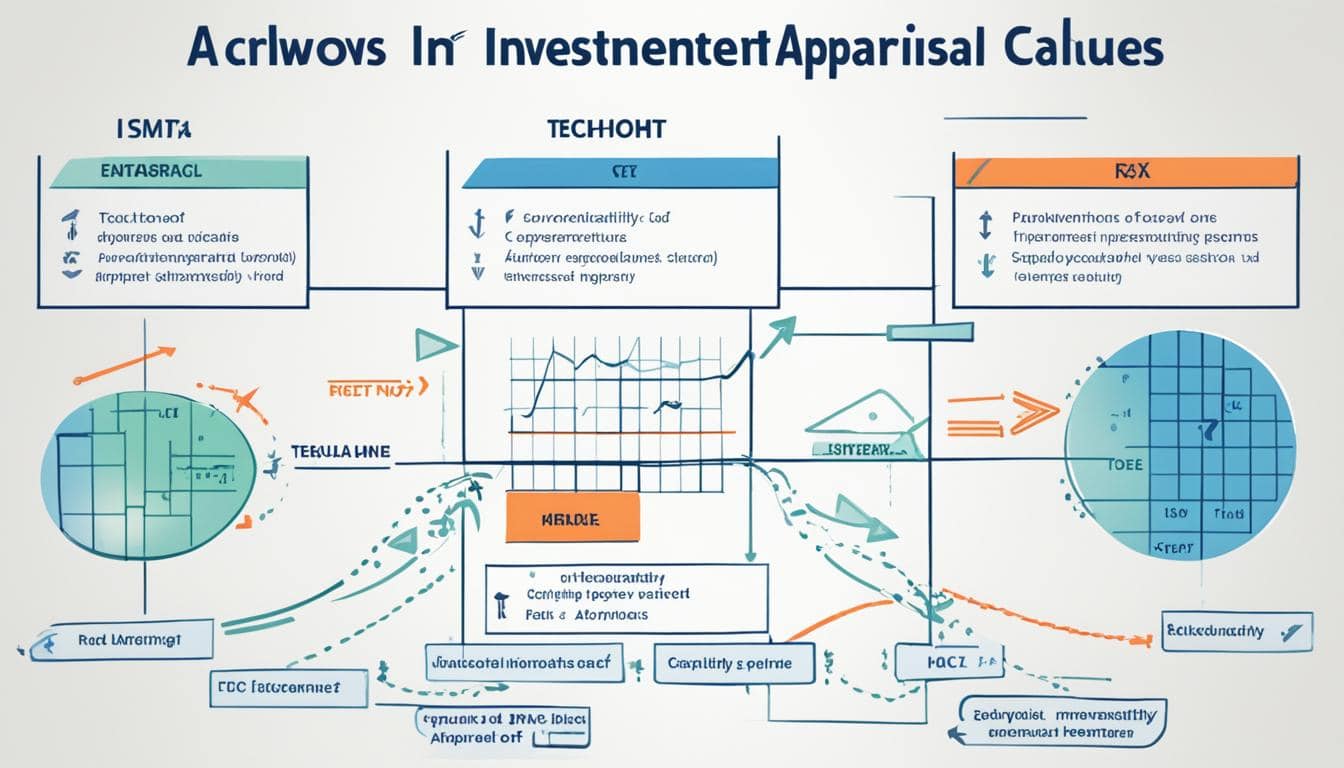
Did you know that making informed financial decisions can optimize your portfolio’s performance?
When it comes to investing, the choices can seem overwhelming. But understanding the right investment appraisal techniques is key to achieving financial success. By utilizing these techniques, you can make strategic decisions and maximize returns while minimizing risks.
In this article, I will guide you through the world of investment appraisal techniques and show you how to navigate the complexities of the financial markets. From non-discounted cash flow methods to discounted cash flow methods, we will explore various techniques that can help you make smarter financial decisions.
Whether you’re an experienced investor or just starting out, this article will provide valuable insights into evaluating investments and optimizing your portfolio. Are you ready to unlock the secrets to investment appraisal techniques? Let’s get started!
Non-Discounted Cash Flow (DCF)
When assessing investment opportunities, it’s important to consider both discounted and non-discounted cash flow methods. In this section, we will focus on non-DCF methods, namely the payback period and the average rate of return.
The payback period provides insight into how long it will take to recover the initial investment based on the annual cash flows generated. This metric is helpful for evaluating the timeframe for recouping the invested capital. However, it has limitations as it does not account for the time value of money and may not consider profitability or risk factors.
The average rate of return calculates the average annual return as a percentage of the initial investment cost. It provides an indication of the profitability of an investment over its lifespan. However, it also neglects the time value of money and may not adequately account for risk factors.

In summary, while non-DCF methods such as the payback period and average rate of return offer a straightforward way to evaluate investments, they have limitations that should be considered when making financial decisions. In the next section, we will explore the discounted cash flow (DCF) methods that provide a more comprehensive approach by considering the time value of money.
Discounted Cash Flow (DCF)
When evaluating investment opportunities, it is crucial to consider the time value of money. Discounted cash flow (DCF) methods provide a more accurate assessment of investment value by accounting for this important factor.
One commonly used DCF method is the Net Present Value (NPV) calculation. NPV determines the difference between the present value of cash inflows and outflows, taking into consideration a discount rate. By discounting future cash flows, NPV quantifies the value added to an investment.
Another essential DCF method is the Internal Rate of Return (IRR). IRR is the rate at which the NPV becomes zero. It represents the rate of return earned on an investment, considering the time value of money. Investments with a higher IRR are generally more desirable as they offer greater returns.
However, the IRR method is not without limitations. To address these shortcomings, the Modified Internal Rate of Return (MIRR) was developed. MIRR takes into account the cost of capital and reinvestment rate, providing a more comprehensive view of an investment’s profitability.
By utilizing these DCF methods, investors can make more informed decisions about their capital allocation. The NPV, IRR, and MIRR calculations help assess the potential returns and risks associated with different investment opportunities.
Investment analysis using DCF methods has become an industry standard. It offers a robust framework for evaluating projects, investments, and business ventures. Incorporating these techniques into investment appraisal allows for more accurate financial planning and optimization of portfolio performance.
The image above visually represents the concepts of Net Present Value (NPV), Internal Rate of Return (IRR), and Modified Internal Rate of Return (MIRR). These DCF methods play a crucial role in investment analysis and decision-making.
Importance of Investment Tracking
Tracking investment rates is essential for staying informed about market fluctuations, managing risks, and evaluating performance. Real-time awareness plays a crucial role in making timely decisions, allowing investors to capitalize on opportunities and minimize potential losses. By closely monitoring investment portfolios, individuals can proactively adjust their strategies based on asset performance, mitigating risks and maximizing returns.
Risk management is a key component of investment tracking. By regularly reviewing and analyzing asset performance, investors can identify underperforming assets and take necessary actions to mitigate risks. This may involve diversifying the portfolio, reallocating investments, or even exiting certain positions to minimize potential losses.
Performance evaluation is another critical aspect of investment tracking. By assessing the performance of individual assets and the overall portfolio, investors can gain valuable insights into their investment strategy. Identifying underperforming assets allows for adjustments to be made, potentially improving the overall portfolio performance.
Here are a few financial tips to help optimize investment tracking:
- Utilize technology: Embrace financial apps and online platforms that provide real-time market data, personalized portfolio tracking, and performance analytics. These tools enable investors to stay up-to-date with the latest market trends and track their investments more efficiently.
- Diversify your portfolio: Spread your investments across different asset classes to minimize risks. Diversification can help reduce the impact of poor performance in one area and increase the overall stability of your portfolio.
- Set clear goals: Define your investment goals and objectives. Whether you’re saving for retirement, a major purchase, or a specific financial milestone, having clear goals provides a framework for making investment decisions and measuring success.
- Stay informed: Continuously educate yourself about the financial markets and investment trends. Stay updated on relevant news, economic indicators, and changes in regulations that may impact your investments.
- Regularly rebalance: Periodically review and rebalance your investment portfolio to maintain the desired asset allocation. Adjusting the weights of different asset classes helps ensure alignment with your risk tolerance and long-term goals.
- Seek professional advice: Consider consulting with a financial advisor who can provide personalized guidance based on your individual financial situation and goals. An expert can help you navigate complex investment decisions and optimize your portfolio.

Utilize Technology
Technology revolutionizes investment tracking, providing individuals with powerful tools to enhance their financial decisions. Financial apps and online platforms offer real-time market data, personalized portfolio tracking, and performance analytics, empowering investors to make informed choices.
Real-time Market Data
With access to real-time market data, investors can stay updated on the latest trends and fluctuations. This allows for timely decision-making, enabling individuals to capitalize on opportunities that arise and mitigate potential risks.
Personalized Portfolio Tracking
Financial apps and online platforms offer personalized portfolio tracking, giving investors a comprehensive view of their investments in a single dashboard. This enables individuals to monitor the performance of their assets, analyze historical data, and identify areas for potential improvement.
Performance Analytics
Investment tracking tools provide performance analytics, offering valuable insights into the profitability and risk of different investment strategies. By analyzing historical performance and assessing key metrics, individuals can make informed decisions to optimize their portfolio’s performance.
The utilization of financial apps and online platforms streamlines the investment tracking process, making it more efficient and accessible. By harnessing technology, investors can stay ahead of the game, adapting their strategies to the ever-changing market conditions and achieving their financial goals.

Diversification is Key
In order to mitigate risks and optimize the performance of your investment portfolio, diversification across various asset classes is crucial. By spreading your investments across different types of assets, such as stocks, bonds, real estate, and commodities, you can reduce the impact of poor performance in one specific asset class on the overall portfolio.
Diversification helps to protect your portfolio against volatility in the market by ensuring that you are not overly exposed to a single asset class. By including a mix of different asset classes, you can potentially achieve a more stable and consistent return over the long term.
Regularly reviewing and adjusting your diversification strategy based on market conditions and financial objectives is important. As different asset classes perform differently over time, it is necessary to rebalance your portfolio periodically to maintain the desired asset allocation. This involves selling assets that have performed well and buying assets that have underperformed, bringing your portfolio back in line with your target allocation.
Implementing a diversification strategy requires careful planning and analysis of your risk tolerance, financial goals, and time horizon. By diversifying your investment portfolio, you can reduce the volatility and potential losses associated with investing in a single asset class. It is advisable to seek professional advice from a financial advisor or investment manager to help you develop an effective diversification strategy that aligns with your specific needs and objectives.
Set Clear Goals
When it comes to making investment decisions, setting clear goals and defining the time horizon plays a crucial role. Clear investment goals provide a framework that guides decision-making and ensures that your investments align with your desired outcomes. Whether you’re saving for retirement, a major purchase, or education, having well-defined objectives helps you stay focused and make informed choices.
By setting specific investment goals, you can allocate your resources effectively and create a plan tailored to your financial needs. Whether you aim to generate passive income, achieve capital growth, or preserve capital, having a clear goal allows you to select investment vehicles that align with your objectives and risk tolerance.
Defining the time horizon is equally important. It refers to the duration you expect to hold your investments before needing to liquidate them to meet your goals. Different investment goals may have varying time horizons, ranging from short-term goals, like saving for a vacation in a year, to long-term goals, such as planning for retirement in 30 years.
Once you have established your investment goals and time horizon, it’s essential to regularly reassess and adjust your portfolio. As life circumstances change or as you progress towards your goals, you may need to reallocate your investments or revise your strategy. Regular evaluation ensures that your investments remain aligned with your objectives and allows you to make any necessary changes to stay on track.
Conclusion
Mastering Investment Appraisal Techniques is crucial for making sound financial decisions and optimizing portfolio performance. By understanding and employing these methods, individuals can confidently navigate the complexities of the financial markets.
Continuous tracking is a vital aspect of investment management. Real-time awareness of market fluctuations enables timely decision-making and risk management. Utilizing technology such as financial apps and online platforms provides access to real-time market data and personalized portfolio tracking.
Diversification plays a key role in reducing risk. Spreading investments across different asset classes minimizes the impact of underperforming assets on the overall portfolio. Regularly assessing and adjusting your diversification strategy based on market conditions and financial goals is essential for achieving long-term success.
Setting clear investment goals and defining the time horizon ensures that your portfolio aligns with your desired outcomes. Regularly reassessing and adjusting your investment strategy based on these goals helps you stay on track and make informed investment decisions.
In summary, mastering investment appraisal techniques, coupled with continuous tracking, diversification, goal-setting, and staying informed, are fundamental elements in achieving financial success. Seeking professional advice can provide valuable insights tailored to your unique financial situation. With these strategies in place, you can confidently navigate the financial markets and optimize your portfolio’s performance.
FAQ
What are investment appraisal techniques?
Investment appraisal techniques are financial methods used to evaluate and analyze investment opportunities. These techniques help individuals make informed decisions about where to invest their funds and how to optimize the performance of their investment portfolios.
What are the non-discounted cash flow (DCF) methods?
The non-DCF methods include the payback period and average rate of return. The payback period calculates the time it takes to recover the initial investment based on annual cash flows. The average rate of return calculates the average annual return as a percentage of the initial investment cost.
What are the discounted cash flow (DCF) methods?
The DCF methods include net present value (NPV), internal rate of return (IRR), and modified internal rate of return (MIRR). Net present value calculates the difference between the present value of cash inflows and outflows, considering a discount rate. Internal rate of return is the rate at which the NPV is zero. Modified internal rate of return addresses limitations of IRR by considering the cost of capital and reinvestment rate.
Why is investment tracking important?
Investment tracking is important because it provides real-time awareness about market fluctuations, helps in managing risks, and allows for the evaluation of portfolio performance. By staying informed and tracking investments, investors can make timely decisions and adjust their investment strategies as needed.
How can technology be utilized in investment tracking?
Technology plays a crucial role in investment tracking. Financial apps and online platforms provide real-time market data, personalized portfolio tracking, and performance analytics. Utilizing these tools can make the tracking process more efficient and accessible.
Why is diversification important for investment portfolios?
Diversifying the investment portfolio across various asset classes helps mitigate risks. By spreading investments, the impact of poor performance on the overall portfolio is reduced. It is important to regularly review and adjust the diversification strategy based on market conditions and financial objectives.
How can setting clear goals benefit investment decisions?
Setting clear investment goals and defining the time horizon helps guide decision-making. Whether it’s saving for retirement, a major purchase, or education, clear objectives ensure investments align with the desired outcomes. Regular reassessment and adjustment of the portfolio based on goals is crucial.
What is the importance of mastering investment appraisal techniques?
Mastering investment appraisal techniques is essential for making informed financial decisions and optimizing portfolio performance. By understanding the various methods and incorporating them into investment analysis, individuals can navigate the complexities of the financial markets with confidence. Continuous tracking, diversification, goal-setting, and staying informed are key elements in achieving financial success. Seeking professional advice can provide valuable insights and recommendations tailored to individual financial situations.
Source Links
- https://www.linkedin.com/pulse/mastering-investment-tracking-guide-financial-success-hf4hf
- https://www.linkedin.com/pulse/mastering-investment-analysis-unlocking-power-fariborz
- https://www.ferventlearning.com/courses/investment-appraisal-mastery/
